
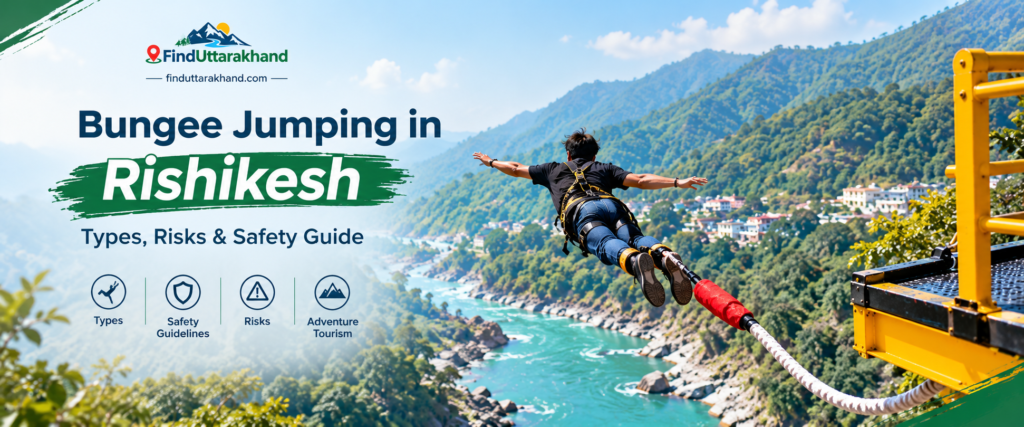
Bungee jumping in rishikesh has grown from a niche thrill into a regular part of the country’s adventure scene. It is also an activity where small mistakes can have serious consequences, so knowing how it works matters before you book. This guide explains the basics, the main formats, the risks, and the safety standards that apply in India.
What Is Bungee Jumping?
If you are asking what is bungee jumping, the short answer is this: a person jumps from a high structure while attached to a long elastic cord. The cord stretches to slow the fall, then pulls the jumper back up in a series of rebounds until the movement settles. A trained crew then lowers the jumper safely.
The thrill comes from the controlled free fall. The safety comes almost entirely from equipment, procedure and people, not from the jumper’s courage.
How Does Bungee Jumping in Rishikesh Work?
The cord stores energy as it stretches. During the fall, the jumper’s height energy is converted into stretch in the cord, which then slows the jumper and rebounds.
Because of this, the cord has to match the jumper. Operators use weight and cord data to select the right setup, and a jump master checks the harness and attachments before each jump. Good operators repeat these checks every time.
Types of Bungee Jumping
The types of bungee jumping you may come across differ in how you are attached and how you land. Not every format is offered everywhere.
- Ankle-cord jump: The classic version, with padded ankle attachment, usually from a fixed platform, bridge or tower.
- Body-harness jump: A harness around the waist or chest, often chosen by people who prefer not to hang by the ankles.
- Water-touch jump: The jumper is dipped toward water. This adds hazards, so it needs extra care with cord length and rescue arrangements.
- Reverse bungee: The jumper is launched upward by the stretched cord, rather than dropped.
- Tandem jump: Two people jump together. This changes weight and rebound, so it needs operator-specific planning.
Related activities, such as a giant swing or a flying fox, use different equipment and carry their own risks.
Bungee Jumping Safety Guidelines
India has no standard written specifically for bungee jumping, so operators of bungee jumping in rishikesh are guided by industry documents. The industry guidance, published by the Adventure Tour Operators Association of India (ATOAI) and hosted on the Ministry of Tourism’s website, recommends following the Australian and New Zealand standard AS/NZS 5848:2000. The document uses “recommended” language, so it reads as industry guidance, not a law.
These bungee jumping safety guidelines cover several areas:
- Equipment: Certified gear from reputable suppliers, regularly inspected, with records kept. Rubber cords should have a recorded shelf life and be stored away from sunlight and heat.
- Staff: At least two qualified jump masters, with first aid and CPR training. The jump master’s decision is final.
- Medical screening: Medical restrictions should be displayed clearly, including heart conditions, high blood pressure, neurological disorders, back problems, recent fractures or surgery, epilepsy, osteoporosis and pregnancy. Jumpers should sign a fitness declaration.
- Age and weight: The ATOAI document lists limits for age and weight. Operators may apply their own, so ask.
- Briefing and records: A safety briefing, daily and periodic inspection logs, incident records and insurance.
- Emergency readiness: A rescue plan, regular drills, a doctor on call and a tie-up with a local hospital.
Understanding Bungee Jumping Risks
Honest bungee jumping risks fall into three groups.
Equipment and procedure. The biggest dangers are human and technical: the wrong cord for the jumper’s weight, a poorly attached harness or ankle strap, worn gear, or skipped checks. These are exactly what good procedures are meant to prevent.
Medical. The sudden stop and rebound can stress the neck, spine and eyes. A published case report described bleeding in the white of both eyes in a jumper that resolved within a week with conservative care, and the authors noted that causes and risk factors need more study. Existing health conditions can make a jump more dangerous.
Conditions. Wind, rain, poor visibility and fatigue can all affect a jump. A responsible operator will delay or cancel in poor conditions.
It is also worth knowing that India’s Ministry of Tourism has said it does not maintain data on accidents in adventure tourism. That makes it harder to compare operators by statistics, and it is a reason to check safety arrangements yourself.
History and Evolution of Bungee Jumping
The idea has older roots in the land-diving ritual of Pentecost Island in Vanuatu, where men jump from wooden towers with vines tied to their ankles.
The modern sport began in the late 1970s, when members of Britain’s Dangerous Sports Club jumped from the Clifton Suspension Bridge in Bristol. Sources differ on the exact year, with 1979 commonly cited. New Zealander A. J. Hackett then worked on latex cords for commercial use, jumped from the Eiffel Tower in 1987, and opened a commercial operation in New Zealand in 1988. From there, the activity spread worldwide, eventually reaching India.
Bungee Jumping Myths vs Facts
Myth: Any cord works for anyone. Fact: Cord choice depends on the jumper, and good operators adjust for it.
Myth: A quick form is enough. Fact: Medical screening is a safety step. Hiding a condition puts you at risk.
Myth: India has one national bungee law. Fact: There is no bungee-specific Indian standard. Industry guidance points to an Australian and New Zealand standard, and the Ministry says adventure safety is primarily the responsibility of state governments.
Myth: If you can afford it, it is safe. Fact: Price tells you little. Look at equipment, staff training and records.
Adventure Tourism in India
Bungee jumping in rishikesh sits within the wider field of adventure tourism in India, which covers river rafting, trekking, paragliding, skiing and more, often in mountain and river regions. The Ministry of Tourism, with ATOAI, has formulated adventure safety guidelines and circulated them to states and union territories for adoption. In a Rajya Sabha reply in April 2026, the Ministry said it recognises 77 adventure tour operators across 19 states, and that states are asked to keep a strict watch on operators and licensing.
Adventure Sports Safety Rules
These adventure sports safety rules apply well beyond bungee:
- Check that the operator is licensed in the state where it works.
- Ask who the lead staff are and what first aid or rescue training they hold.
- Read the medical restrictions honestly and disclose any condition.
- Ask about insurance and the emergency plan.
- Expect a briefing and a signed declaration, and ask questions.
- Do not jump if you feel unwell, tired, or pressured.
Environmental Impact of Adventure Tourism
Adventure tourism depends on landscapes that are easily affected. Common concerns include litter, trampling and soil erosion near sites, noise that disturbs wildlife, and pressure on water and sanitation during busy periods. Camps, access roads and structures also change the places they sit in.
Visitors can help by carrying out all waste, staying on marked paths, respecting wildlife and local rules, and choosing operators who manage waste and limit group sizes. These are general principles, so follow any site-specific rules.
Final Thoughts
Bungee jumping in rishikesh can be done more safely when operators follow strong procedures and visitors do their own homework. Whether you are curious or ready to book, check the licence, ask about the equipment and the crew, be honest about your health, and walk away if anything feels rushed. Adventure sports reward preparation.
Find Uttarakhand is a local tourism and business directory. We do not operate adventure activities, give medical advice or guarantee any operator’s safety.