
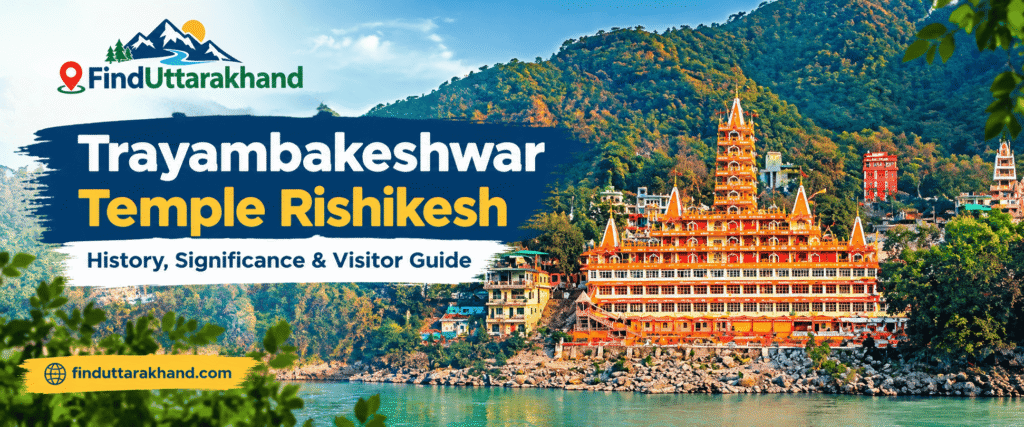
Located beside the Ganga near Lakshman Jhula, Trayambakeshwar Temple Rishikesh is one of the town’s most recognisable religious landmarks. Its distinctive thirteen-storey structure, multiple shrines and riverside setting make it an important stop for visitors exploring Rishikesh. The temple is also popularly known as the 13 Manzil Mandir Rishikesh and Tera Manzil Mandir Rishikesh.
Whether you are interested in religious traditions, temple architecture or the cultural heritage of Uttarakhand, this guide explains the temple’s location, history, spiritual significance and practical visitor information.
Where Is Trayambakeshwar Temple Rishikesh Located?
Trayambakeshwar Temple stands beside the Ganga in the Lakshman Jhula area of Rishikesh, Uttarakhand. Its location makes it easy to include in a walking visit to the surrounding riverside neighbourhood, where visitors will find ashrams, shops, cafés and other religious landmarks.
The temple is especially noticeable because of its tall structure overlooking the river. Its position also offers views of the Ganga and the surrounding hills from the area.
How to Reach the Temple
Visitors can reach the Lakshman Jhula neighbourhood by road from central Rishikesh. Taxis and auto-rickshaws operate in the town, although the availability of vehicles and access to particular lanes can vary with traffic and local restrictions.
- By train: Rishikesh has railway services, including Yog Nagari Rishikesh railway station. Check your arrival station and onward road route before travelling.
- By air: Jolly Grant Airport near Dehradun is the nearest major airport commonly used by visitors to Rishikesh. Travel time depends on traffic and the exact route.
- By road: Rishikesh is connected with Dehradun, Haridwar and other cities by road. From the town, continue towards the Lakshman Jhula area.
Exact distances depend on your starting point and the route available on the day. It is better to check a current map rather than rely on conflicting distances published by travel websites.
Lakshman Jhula and Bajrang Setu
The old Lakshman Jhula bridge was closed in 2019 because of safety concerns. Bajrang Setu, a replacement bridge nearby, was reported open to visitors in August 2026. However, access arrangements for its glass walkways may differ from those for its central pedestrian section.
Before planning your route across the river, check current local directions and any restrictions. Do not assume that every part of a bridge has the same access rules.
History of Trayambakeshwar Temple
The temple’s history combines religious traditions with details that are not fully established by historical evidence. The government’s Incredible India tourism page describes the temple as approximately 1,000 years old and records a traditional account connecting its establishment with Adi Shankaracharya.
Another belief holds that the Shivalinga associated with the temple is swayambhu, a Sanskrit term used for something believed to have manifested naturally rather than being installed by human hands.
These accounts are important to the temple’s religious identity, but they should not automatically be treated as verified historical facts. A definitive construction date, a confirmed founder and detailed archaeological evidence are not clearly established in the commonly available tourism descriptions.
The name also needs clarification. “Trayambakeshwar” is associated with Shiva as the three-eyed lord, while “Tera Manzil” refers to the building’s thirteen floors. The temple should not be confused with the famous Trimbakeshwar Jyotirlinga in Nashik, Maharashtra.
Religious Significance of the Temple
Trayambakeshwar Temple is associated with the worship of Lord Shiva and other Hindu deities represented in its various shrines. Devotees visit to offer prayers, seek blessings and spend time in a setting closely connected with the spiritual traditions of Rishikesh.
The Ganga holds a special place in Hindu belief, and its connection with Lord Shiva is an important part of religious tradition. For many worshippers, visiting a Shiva temple beside the river is therefore meaningful beyond the building itself.
The temple also reflects Rishikesh’s broader identity as a centre of pilgrimage, yoga, meditation and spiritual learning. People visit the town for different reasons, and religious sites such as this one remain part of its cultural landscape.
During important Hindu festivals, including Mahashivratri and the month of Shravan, Shiva temples may receive more devotees than usual. Visitors should allow extra time and follow local instructions if travelling during a festival.
Architecture of the 13 Manzil Mandir Rishikesh
The temple’s most distinctive feature is its thirteen-storey design. Unlike many temples built primarily around a single central shrine, this structure contains shrines associated with different Hindu deities across its floors.
Its height makes it stand out among the buildings along the river. The combination of its vertical design, religious imagery and location near the Ganga gives it a recognisable place in Rishikesh’s townscape.
What Makes Its Architecture Distinctive?
The temple’s floors provide space for multiple shrines and devotional activities. Visitors may encounter different images and representations of Hindu deities as they explore the building.
Some tourism descriptions discuss a combination of North Indian and South Indian architectural influences. However, without a detailed architectural study, it is best not to attribute every feature to a particular style or make claims about a specific architect.
The popular name 13 Manzil Mandir Rishikesh describes the structure itself. The name is widely used by visitors and travel guides because the thirteen floors are the temple’s most noticeable feature.
What Can Visitors See Inside the Temple?
A visit offers more than a view of the building from the riverbank. Visitors can explore the available shrines, observe the religious artwork and experience the devotional atmosphere.
Shrines and Religious Images
Different floors contain shrines associated with Hindu deities. The arrangement allows worshippers to offer prayers at more than one shrine during a visit. The availability of individual areas may vary, so follow instructions from temple staff.
Views of the Ganga
The temple’s position beside the river is one of its main attractions. Views of the Ganga and the surrounding landscape contribute to the experience, although visibility depends on the weather, river conditions and the areas accessible to visitors.
The Temple’s Surroundings
The Lakshman Jhula neighbourhood is known for its religious establishments, small shops and riverside atmosphere. Visitors can explore the surrounding area on foot where local access conditions permit.
When visiting, remember that this is a place of worship as well as a landmark. Avoid disturbing people who are praying, and follow any restrictions on photography.
Timings and Visitor Information
Opening Hours
The Incredible India tourism page lists the temple’s hours as 6:00 AM to 7:00 PM, with a closure from 12:00 PM to 2:00 PM. Timings can change during festivals or due to local arrangements, so confirm them before travelling.
Entry Fee
A current, officially confirmed entry-fee listing was not available in the sources consulted for this guide. Ask at the temple before assuming that a fee does or does not apply.
Best Time to Visit
October to March is generally a comfortable period for exploring Rishikesh because temperatures are often more moderate than during the hotter months. However, weather varies, and festival dates may bring larger crowds.
During the monsoon, wet surfaces and stairs may require additional care. Visitors should avoid rushing while moving between floors.
Clothing and Temple Etiquette
Wear respectful clothing and follow any instructions displayed at the entrance. Remove footwear where required, keep noise low around the shrines and ask permission before photographing people or religious activities.
The building has multiple floors, so visitors who find stairs difficult should consider their comfort before entering. Take breaks when necessary and do not attempt to climb every floor if doing so feels physically uncomfortable.
Conclusion
Trayambakeshwar Temple Rishikesh is a distinctive religious landmark known for its thirteen-storey structure, multiple shrines and location beside the Ganga. Its traditional stories and spiritual associations make it an interesting place to learn about the religious culture of Rishikesh, while its architecture sets it apart from many other temples in the area.
The temple is also popularly called Tera Manzil Mandir Rishikesh because of its thirteen floors. Before visiting, confirm the current opening hours, road access and bridge arrangements. A respectful and unhurried visit allows you to appreciate both the temple’s religious importance and its place in the riverside landscape of Rishikesh.